
The Eurovision Song Contest 1997 was the 42nd edition of the annual Eurovision Song Contest, held on 3 May 1997 at the Point Theatre in Dublin, Ireland. Organised by the European Broadcasting Union (EBU) and host broadcaster Radio Telefís Éireann (RTÉ) and presented by Carrie Crowley and Ronan Keating, the contest was held in Ireland following the country’s victory at the 1996 contest with the song The Voice by Eimear Quinn. The 1997 contest was the seventh – and to date last – edition to be staged in Ireland, as well as the fourth to be produced by RTÉ in five years. The Point Theatre served as the host venue for the third time, following the 1994 and 1995 contests, becoming the only venue to have been the site of three Eurovision Song Contests.
Twenty-five countries participated in the contest, with a new relegation system introduced to determine which nations could participate, based on each country’s average points total in previous contests. Italy made its first appearance since 1993, and Denmark, Germany, Hungary and Russia returned after last competing in 1995, having been prevented from competing the previous year after failing to progress from that event’s qualifying round. Belgium, Finland and Slovakia, participants in the previous year’s contest, were unable to return after being excluded by the new relegation rules.
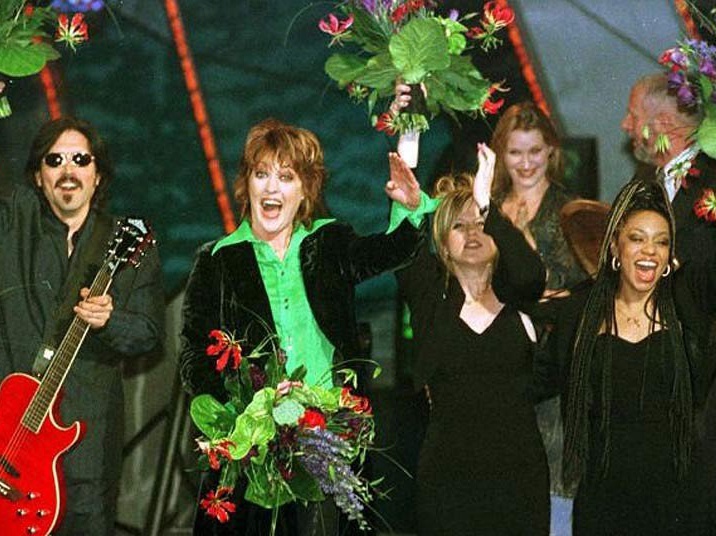
The winner was the United Kingdom with the song Love Shine a Light, written by Kimberley Rew and performed by Katrina and the Waves. Ireland, Turkey, Italy and Cyprus rounded out the top five, with Ireland earning their fifth placing in the top two within six years and Turkey and Cyprus achieving their best results to date. Five of the competing countries used televoting to determine their points, allowing the general viewing public a say in the results for the first time; following this successful trial all countries were encouraged to use this system starting from the following year’s event. Entries were also permitted for the first time to feature no live music accompaniment, with each performance being able to use only a backing track rather than utilising any part of the orchestra or any live instrumentation from the performers themselves.
The 1997 event would prove to be a watershed for the contest, with many aspects of this event leaving a lasting impact on future editions of Eurovision. These included: the first openly LGBT artist, Iceland’s Paul Oscar, selected to compete in the event; changes to contest rules led to the abandonment of live musical accompaniment in future events; a successful trial of televoting in five countries led to widespread adoption for all countries in 1998.

 euro-vision.blog