
Today the 45th edition of the annual Eurovision Song Contest 2000 took place in Stockholm, Sweden, following the country’s victory at the 1999 contest with the song “Take Me to Your Heaven” by Charlotte Nilsson. Organised by the European Broadcasting Union (EBU) and host broadcaster Sveriges Television (SVT), the contest was held at the Globe Arena. The contest was presented by Swedish television presenters Kattis Ahlström and Anders Lundin.

Twenty-four countries took part in the contest. Latvia participated for the first time, while Slovakia, Greece and Hungary decided not to compete, citing financial reasons. Finland, Macedonia, Romania and Switzerland returned after their relegation from the previous edition. Russia also returned, after their last participation in 1997. Meanwhile, Bosnia and Herzegovina, Lithuania, Poland, Portugal and Slovenia were relegated due to having the lowest average scores over the previous five editions.
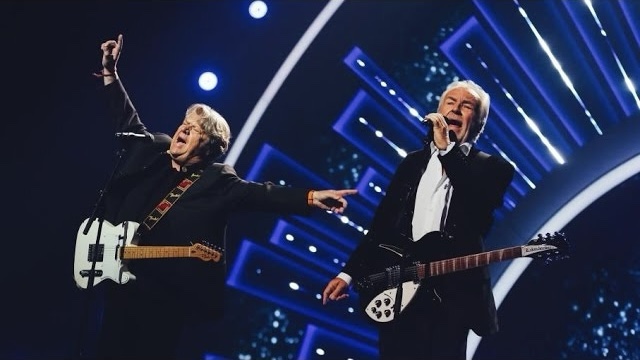
The winner was Denmark with the song “Fly on the Wings of Love”, performed by the Olsen Brothers and written by the oldest brother Jørgen Olsen. This was Denmark’s second victory in the contest, following their win in 1963 almost 4 decades earlier. Russia, Latvia, Estonia and Germany rounded out the top five. Both Russia and Estonia achieved their best result in the contest up to this point, while Latvia achieved the best placing for a debuting country since Poland’s second-place finish in 1994. On the day of their victory, Jørgen Olsen was 50 years and 61 days of age, making him the oldest artist yet to win the contest. The combined ages of the Olsen Brothers make them the oldest aged act ever to win the contest.
Sponsored by Microsoft, the contest was also broadcast in Australia, Canada, Japan, the United States, and via the Internet for the first time.
In the Netherlands, NOS decided to take the contest off air halfway through because of the Enschede fireworks disaster that happened earlier that day, so it could use the channel for continuous news broadcasts. Later, NOS declared that it was both for practical reasons as well as because they found it “inappropriate to broadcast a light entertainment programme on the night of such a catastrophic event”. As a result, televoting had to be suspended and the Dutch votes were given by a stand-by jury instead. The contest was later rebroadcast in full on 12 June 2000.
Today was a warm, almost tropical day in the Netherlands. We spent the day on the beach in Den Helder and heard about the fireworks disaster on our little transistor radio. In the evening, back home in Almere, we continued to watch the broadcast via the BBC, after the NOS took the contest off the air.


 euro-vision.blog