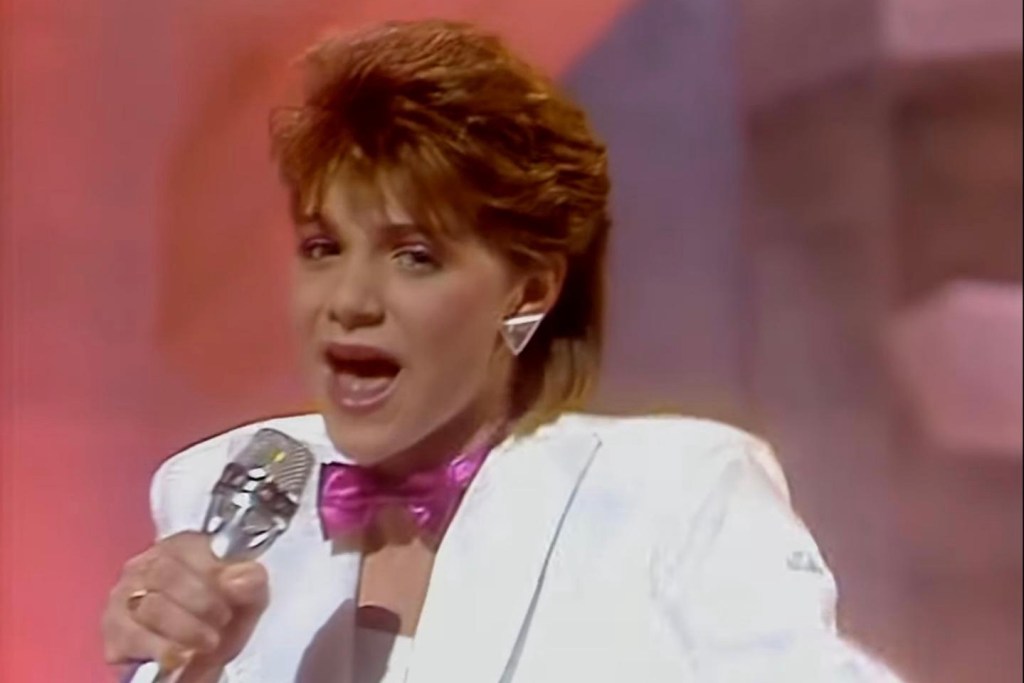
Eurovision 1987

Today the 32nd edition of the annual Eurovision Song Contest took place in Brussels, Belgium, following the country’s victory at the 1986 contest with the song “J’aime la vie” by Sandra Kim. Organised by the European Broadcasting Union (EBU) and host broadcaster Radio-télévision belge de la Communauté française(RTBF), the contest was held at the Centenary Palace on 9 May 1987 (also Europe Day) and hosted by French-Belgian singer Viktor Lazlo.
By 1986, Belgium has participated in the Eurovision Song Contest 30 times since making its debut at the first contest in 1956 along 6 other countries. Before Sandra Kim’s win, Belgium was the only one of the 7 founding countries to have never won the contest and had only twice finished in the top five (with Tonia’s fourth place in 1966 and Jean Vallée’s second place in 1978).

Twenty-two countries took part in the contest with Greece and Italy returning to the competition after their absences the previous year. This set the record for the highest number of competing countries up until that point.

The winner was Ireland with the song “Hold Me Now” by Johnny Logan, who had also won the 1980 contest. He was the first performer to have won the Eurovision Song Contest twice.


Eurovision 1986

Tonight the 31st edition of the annual Eurovision Song Contest 1986 was held in Bergen, Norway, following the country’s victory at the 1985 contest with the song “La det swinge” by Bobbysocks! Organised by the European Broadcasting Union (EBU) and host broadcaster Norsk rikskringkasting (NRK), the contest was held at Grieghallen and was hosted by previous Norwegian contestant Åse Kleveland.

Twenty countries took part in this year’s contest with Greece and Italy deciding not to participate and Yugoslavia and Netherlands returning. Iceland also competed for the first time this year.

Iceland competed for the first time, as the national broadcaster RÚV had finally cemented their satellite television connections with the rest of Europe.

Greece withdrew, as the contest coincided with Holy Saturday on the Eastern Orthodox Church liturgical calendar. Their entry would have been “Wagon-lit” (Βάγκον λι), performed by Polina, who was backing vocalist of Elpida at the 1979 contest (Elpida represented Cyprus this year). Prior to their withdrawal, they were set to be 18th in the running order between Sweden and Denmark. Italian broadcaster RAI, on the other hand, decided not to send any delegation to Bergen.

The winner was Belgium with the song “J’aime la vie” by Sandra Kim. Belgium was the last of the original 7 countries that had competed in the very first contest to win. Aged 13, Kim was the youngest ever Eurovision winner. Current rules require Eurovision Song Contest participants to be at least 16, so unless the rule is changed, Kim’s record will never be broken. In the lyrics of her song, Kim claimed to be 15 years of age, but after the contest, it was revealed that she was actually 13. Switzerland, who finished second, appealed for her to be disqualified, but was not successful.

The 1986 contest was a first for Eurovision in that royalty were among the guests—Crown Prince Harald, Crown Princess Sonja, Princess Märtha Louise and Prince Haakon Magnus were all in attendance.