
What should have been a fun musical party turned out to be a debacle for the Netherlands. Today it turned out that the Netherlands had already reported an unsafe atmosphere before the disqualification. Ireland, Lithuania and Norway also spoke out critically.
“Fuck the EBU!” These are not just the words of Eurovision commentator Cornald Maas after Joost Klein’s disqualification, they are also the words used by Irish artist Bambie Thug after the final of the Eurovision Song Contest. They both addressed the organizer of the festival, the European Broadcasting Union (EBU).
After the final, the Lithuanian entry wrote on social media that it would have been better if the entire party had been stopped after the first semi-final and now the Norwegian band Gate is also speaking out critically. “Withdrawing was an option until the last minute. We ultimately had constructive discussions with the EBU and that was just good enough for us to continue.”
Switzerland, the United Kingdom, Ireland and Portugal are all said to have threatened to withdraw due to the atmosphere behind the scenes, which was described as tense by several participants. On Tuesday it emerged that the Netherlands and Norway were also among the countries that reported the working atmosphere.
When asked, AVROTROS informed nu.nl that it had made an official report of the unsafe atmosphere behind the scenes. They already did that on Friday, when Joost Klein had not yet been disqualified.
The disqualification of Joost Klein may feel like the moment that everything went wrong for the Dutch, but there was already a lot of pressure on the event in the run-up to the Eurovision Song Contest. Israel’s participation made it perhaps the most politically charged edition in the 68 years that the festival has been held.
From the very first Eurovision events, participants were asked for their opinion on Israel’s entry, which sometimes led to emotional moments. After the final, Bambie Thug was crying to journalists because they had experienced so much pressure to ignore political opinions that it no longer felt sincere.
Bambie Thug is also the artist who was commissioned by the organization to remove the word ‘ceasefire’ in old Irish script from their face. The watermelon, painted on the chest of Australia’s entry was overlooked by the organization: the fruit is also seen as a statement of support for the Palestinians. Former participant Eric Saade received an angry response from the EBU after he wore a kaffiya during a performance. The scarf also symbolizes a signal of commitment to Palestine.
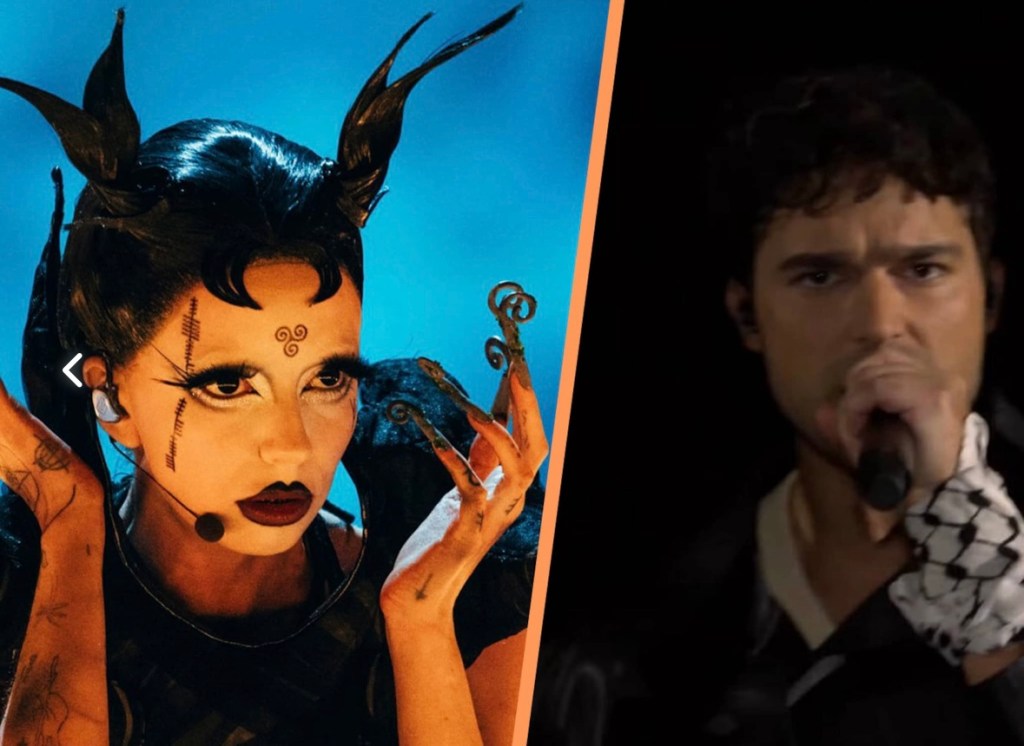
Things also went wrong in the commentators’ booths. For example, the Israeli colleague of Cornald Maas and Jacqueline Govaert announced the Irish entry as “the artist who speaks negatively about Israel”. The Irish delegation then filed a complaint with the EBU and the commentator was reprimanded.
The performance of Portuguese singer Iolanda during the final never appeared on social media because she had, among other things, the Palestinian flag painted on her nails. Such a political statement is prohibited according to the rules of the Eurovision Song Contest and therefore the artist could have been disqualified. It is unclear why this did not happen.
The Portuguese broadcaster RTP has not only been critical of the exclusion of Iolanda’s performance on social media, they also find it unacceptable that the EBU used an “anti-booing system” during the semi-final and final. As a result, the booing of the EBU and Israel’s entry was less received by the viewers at home than in the audience.
“For an organization like the EBU and for an organization like RTP and the European public media service, the fight against fake news, misinformation and the manipulation of information is a constant battle. It is unacceptable that this is possible. This method distorts the truth.”
AVROTROS is also critical: “We believe that when a musician performs you should always show what it does to the audience.”
As always, the European Broadcasting Union is difficult to reach, but responded to the angry reactions in an official statement. The organization places the blame mainly on the participating countries themselves.
“We find it very unfortunate that some delegations did not adhere to the rules during the event and during broadcasts. We have spoken to several delegations about incidents that have come to our attention. The EBU continues to engage with the chairmen of delegations and will do an evaluation of this Eurovision Song Contest.”
“In this way we hope to be able to move forward in a positive way, in a way where everyone respects the values of this event. Individual problems will be discussed in a subsequent meeting.” Source: nu.nl



 euro-vision.blog