
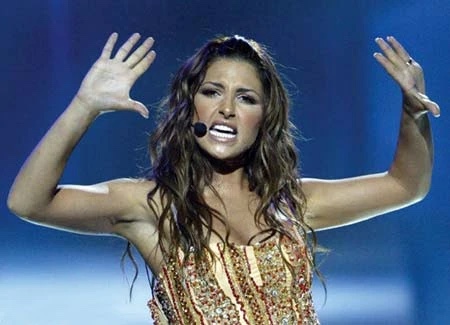
This week the 51th edition of the annual Eurovision Song Contest took place in Athens, Greece, following the country’s victory at the 2005 contest with the song My Number One by Helena Paparizou. Organised by the European Broadcasting Union(EBU) and host broadcaster Hellenic Broadcasting Corporation (ERT), the contest was held at the Nikos Galis Olympic Indoor Hall, and consisted of a semi-final on 18 May, and a final on 20 May 2006. The two live shows were presented by American television personality Maria Menounos and Greek former contestant Sakis Rouvas.
Thirty-seven countries participated in the contest. Armenia took part for the first time. Meanwhile, Austria, Hungary, and Serbia and Montenegro announced their non-participation in the contest. Serbia and Montenegro had intended to participate, but due to a scandal in the national selection, tensions were caused between the Serbian broadcaster, RTS, and the Montenegrin broadcaster, RTCG. Despite this, the nation did retain voting rights for the contest.
The semi-final was held on 18 May 2006 at 21:00 (CET). 23 countries performed and all 37 participants and Serbia and Montenegro voted.
The semi-final opened with a medley of former Eurovision songs performed by Greek gods: Welcome to the Party (runner-up at the Ellinikós Telikós 2006) of Anna Vissi performed by Muses, Nel blu, dipinto di blu (Italy 1958) of Domenico Modugno performed by Zeus, L’amour est bleu (Luxembourg 1967) of Vicky Leandros performed by Poseidon, Save Your Kisses for Me (United Kingdom 1976) of Brotherhood of Man performed by Hermes, Making Your Mind Up (United Kingdom 1981) of Bucks Fizz performed by Athena, A-Ba-Ni-Bi (Israel 1978) of Izhar Cohen & The Alphabeta performed by Hephaestus, Dschinghis Khan (Germany 1979) of Dschinghis Khan performed by Ares, Diva (Israel 1998) of Dana International performed by Aphrodite, Waterloo (Sweden 1974) of ABBA performed by Charites, Wild Dances (Ukraine 2004) of Ruslana performed by Artemis and My Number One (Greece 2005) of Helena Paparizou performed by the ensemble cast of the Greek gods. In addition, the hosts Maria Menounos and Sakis Rouvas sang the winning song of the 1997 contest, Love Shine a Light of Katrina and the Waves, representing the United Kingdom.
Following Istanbul’s Under The Same Sky and Kyiv’s Awakening, the slogan for the 2006 show was Feel The Rhythm. This theme was also the basis for the postcards for the 2006 show, which emphasized Greece’s historical significance as well as being a major modern tourist destination.
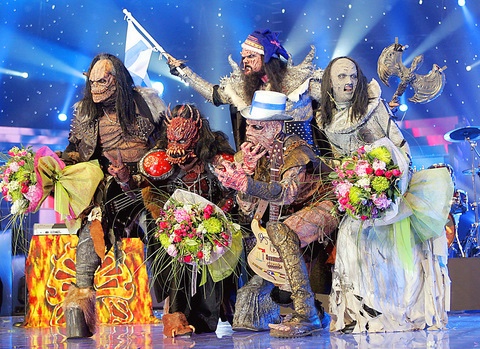
The winner was Finland with the heavy metal-song Hard Rock Hallelujah, performed by Lordi and written by lead singer Mr. Lordi. This was Finland’s first victory in the contest – and first top five placing – in 45 years of participation, the longest time a country had competed without a win at that point. It was also the first ever hard rock song to win the contest, as well as the first band to win since 1997. Russia, Bosnia and Herzegovina, Romania and Sweden rounded out the top five. Bosnia and Herzegovina achieved their best result in their Eurovision history. Further down the table, Lithuania also achieved their best result to date, finishing sixth. Of the Big Four countries Germany placed the highest, finishing joint fourteenth (with Norway).
 euro-vision.blog