Eurovision 2007

This week the 52nd edition of the annual Eurovision Song Contest was held in Helsinki, Finland, following the country’s victory at the 2006 contest with the song Hard Rock Hallelujah by Lordi. Organised by the European Broadcasting Union (EBU) and host broadcaster Yleisradio (YLE), the contest was held at the Hartwall Areena, and consisted of a semi-final on 10 May, and a final on 12 May 2007. The two live shows were presented by Finnish television presenter Jaana Pelkonen and musician and TV-host Mikko Leppilampi. In addition, Krisse Salminen acted as guest host in the green room, and reported from the crowds at the Senate Square.
Forty-two countries participated in the contest – three more than the previous record of thirty-nine, that took part in 2005. The EBU decided to put aside its limit of 40 countries, which would have meant excluding some countries using a ranking order scheme. The Czech Republic and Georgia participated for the first time this year, with Montenegro and Serbia taking part as independent nations for the first time. Austria and Hungary both returned, after their absence from the previous edition. Meanwhile, Monaco decided not to participate, despite initially confirming participation. Monaco has not competed in Eurovision Song Contest ever since.

On 12 March 2007, the draws for the running order for the semi-final, final and voting procedure took place. A new feature allowed five wild-card countries from the semi-final and three countries from the final to choose their starting position. The heads of delegation went on stage and chose the number they would take. In the semi-final, Austria, Andorra, Turkey, Slovenia and Latvia were able to choose their positions. In the final, Armenia, Ukraine and Germany were able to exercise this privilege. All countries opted for spots in the second half of both evenings. Shortly after the draw, the entries were approved by the EBU, ending the possibility of disqualification for the Israeli song. The United Kingdom chose their entry after the deadline because they were granted special dispensation from the EBU.

The contest saw some minor changes to the voting time-frame. The compilation summary video of all entries including phone numbers was shown twice. The voting process was the same as 2006 except there was fifteen minutes to vote, an increase of five minutes on the 2006 contest. In the final, the results from each country were once again shown from one to seven points automatically on screen and only eight, ten and twelve were read by the spokespeople.

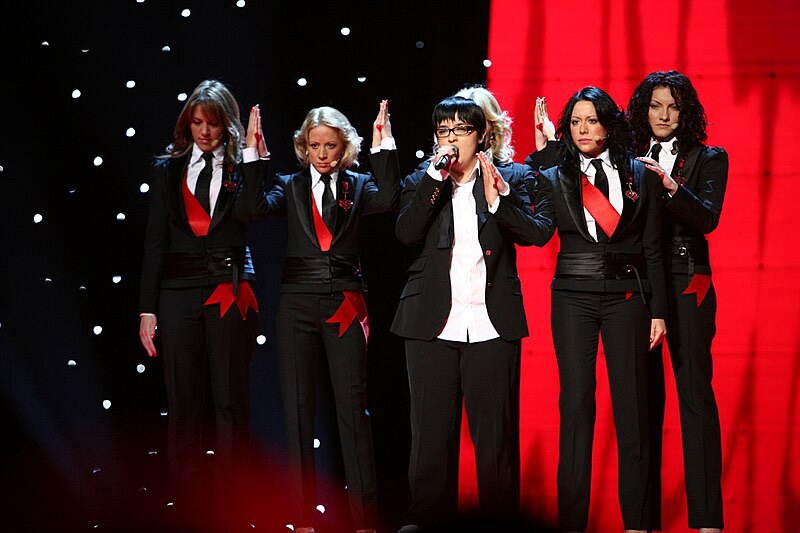
The winner was Serbia with the song Molitva, performed by Marija Šerifović and written by Vladimir Graić and Saša Milošević Mare. This was Serbia’s first victory in the contest, coincidentally the first year it competed as an independent nation. It was also the first winning song entirely performed in a country’s native language since Israel’s Diva in 1998. Ukraine, Russia, Turkey and Bulgaria rounded out the top five. Further down the table, Belarus achieved their best placing to date, finishing sixth. Meanwhile, Ireland achieved its worst placing in the contest up until that point, finishing twenty-fourth (last place) in the final. Of the Big Four countries, Germany placed the highest, finishing nineteenth.
Eurovision 2006

This week the 51th edition of the annual Eurovision Song Contest took place in Athens, Greece, following the country’s victory at the 2005 contest with the song My Number One by Helena Paparizou. Organised by the European Broadcasting Union(EBU) and host broadcaster Hellenic Broadcasting Corporation (ERT), the contest was held at the Nikos Galis Olympic Indoor Hall, and consisted of a semi-final on 18 May, and a final on 20 May 2006. The two live shows were presented by American television personality Maria Menounos and Greek former contestant Sakis Rouvas.

Thirty-seven countries participated in the contest. Armenia took part for the first time. Meanwhile, Austria, Hungary, and Serbia and Montenegro announced their non-participation in the contest. Serbia and Montenegro had intended to participate, but due to a scandal in the national selection, tensions were caused between the Serbian broadcaster, RTS, and the Montenegrin broadcaster, RTCG. Despite this, the nation did retain voting rights for the contest.

The semi-final was held on 18 May 2006 at 21:00 (CET). 23 countries performed and all 37 participants and Serbia and Montenegro voted.

The semi-final opened with a medley of former Eurovision songs performed by Greek gods: Welcome to the Party (runner-up at the Ellinikós Telikós 2006) of Anna Vissi performed by Muses, Nel blu, dipinto di blu (Italy 1958) of Domenico Modugno performed by Zeus, L’amour est bleu (Luxembourg 1967) of Vicky Leandros performed by Poseidon, Save Your Kisses for Me (United Kingdom 1976) of Brotherhood of Man performed by Hermes, Making Your Mind Up (United Kingdom 1981) of Bucks Fizz performed by Athena, A-Ba-Ni-Bi (Israel 1978) of Izhar Cohen & The Alphabeta performed by Hephaestus, Dschinghis Khan (Germany 1979) of Dschinghis Khan performed by Ares, Diva (Israel 1998) of Dana International performed by Aphrodite, Waterloo (Sweden 1974) of ABBA performed by Charites, Wild Dances (Ukraine 2004) of Ruslana performed by Artemis and My Number One (Greece 2005) of Helena Paparizou performed by the ensemble cast of the Greek gods. In addition, the hosts Maria Menounos and Sakis Rouvas sang the winning song of the 1997 contest, Love Shine a Light of Katrina and the Waves, representing the United Kingdom.

Following Istanbul’s Under The Same Sky and Kyiv’s Awakening, the slogan for the 2006 show was Feel The Rhythm. This theme was also the basis for the postcards for the 2006 show, which emphasized Greece’s historical significance as well as being a major modern tourist destination.

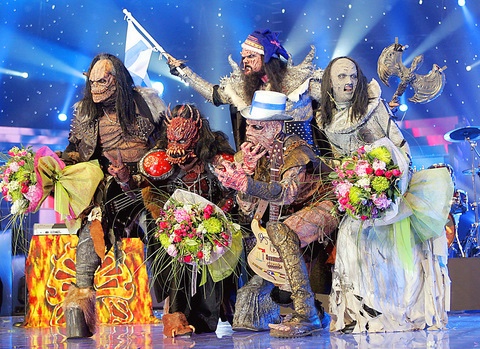
The winner was Finland with the heavy metal-song Hard Rock Hallelujah, performed by Lordi and written by lead singer Mr. Lordi. This was Finland’s first victory in the contest – and first top five placing – in 45 years of participation, the longest time a country had competed without a win at that point. It was also the first ever hard rock song to win the contest, as well as the first band to win since 1997. Russia, Bosnia and Herzegovina, Romania and Sweden rounded out the top five. Bosnia and Herzegovina achieved their best result in their Eurovision history. Further down the table, Lithuania also achieved their best result to date, finishing sixth. Of the Big Four countries Germany placed the highest, finishing joint fourteenth (with Norway).

Songs

It’s that time of year again: the Eurovision Song Contest. Last year I was enjoying the show in my PJ’s on the couch, but tonight Edo and I are going to visit friends with several people to experience the ‘annual spectacle’ in a group. The exciting question Will We Win This Year? has been taken from us, so we will relax and only have eyes for the beautiful men and the ugly dresses.

Image Hosted by ImageShack.us