Claude’s performance in the final of the Eurovision Song Contest was most appreciated by viewers in Greece and Iceland. In both countries, the Dutch singer received six points, good for fifth place.
In total, Claude received 42 points from the viewers for his performance with C’est La Vie. He had hoped for more, the singer said after the Song Contest in Basel, Switzerland.
Fourteen of the 37 countries gave Claude audience points. Claude eventually came twelfth. He owed that largely to the points of the professional juries. He received a total of 133 points from 23 countries.
The juries of Ireland, Poland, Spain and Iceland gave Claude ten points, the second highest score. Source: nu.nl
Sinds vorige week heb ik besloten om iedere dinsdag hier op dit ‘draystation’ een inzending voor het Eurovisie Songfestival 2010 te plaatsen. Vorige week was dat mijn favoriet (tot nu toe); België. Vandaag de inzending van Griekenland.
Dit land stuurt Giorgos Alkaios & Friends naar Oslo met het nummer ‘OPA!’. Het lied is er één van dertien in een dozijn. Veel dansers, kreten (opa!), een viool-riedeltje (winnaar vorig jaar) en af en toe lijkt het alsof het mobieltje van een van de dansers afgaat.
Ik denk wel dat Griekenland in de top 5 komt. Natuurlijk winnen ze niet, want de financiële situatie misère van Griekenland laat geen organisatie voor het songfestival 2011 toe. En als ik heel eerlijk ben zorgt het lied ‘Opa!’ er zelf wel voor dat het net geen overwinning wordt.
Het Songfestival is weer ouderwets retro en vintage. Afgelopen week ging er geen dag voorbij of er viel wel iets te melden over onze Toppers in Moskou. Viel de afgelopen jaren het Eurovisie Songfestival niet meer op en trokken de Nederlanders de schouders op als men vroeg wie er voor Nederland afgevaardigd was, nu is dat anders. Schandalen en tragedies zijn weer aan de orde van de dag. Het Eurovisie Songfestival is weer op de kaart gezet. Nu Nederland nog door naar de finale!
Over een half uur begint de tweede halve finale en nu nog even snel een voorspelling doen. Eens zien of mijn muzikale smaak nog gelijk is aan die van de gemiddelde Europeaan. Ik ga voor en hoop vooral dat de volgende tien landen naar de finale door gaan: Polen, Noorwegen, Cyprus, Denemarken, Hongarije, Azerbeidzjan, Griekenland, Litouwen, Oekraïne en dan toch Nederland.
This week the 51th edition of the annual Eurovision Song Contest took place in Athens, Greece, following the country’s victory at the 2005 contest with the song My Number One by Helena Paparizou. Organised by the European Broadcasting Union(EBU) and host broadcaster Hellenic Broadcasting Corporation (ERT), the contest was held at the Nikos Galis Olympic Indoor Hall, and consisted of a semi-final on 18 May, and a final on 20 May 2006. The two live shows were presented by American television personality Maria Menounos and Greek former contestant Sakis Rouvas.
Thirty-seven countries participated in the contest. Armenia took part for the first time. Meanwhile, Austria, Hungary, and Serbia and Montenegro announced their non-participation in the contest. Serbia and Montenegro had intended to participate, but due to a scandal in the national selection, tensions were caused between the Serbian broadcaster, RTS, and the Montenegrin broadcaster, RTCG. Despite this, the nation did retain voting rights for the contest.
The semi-final was held on 18 May 2006 at 21:00 (CET). 23 countries performed and all 37 participants and Serbia and Montenegro voted.
The semi-final opened with a medley of former Eurovision songs performed by Greek gods: Welcome to the Party (runner-up at the Ellinikós Telikós 2006) of Anna Vissi performed by Muses, Nel blu, dipinto di blu (Italy 1958) of Domenico Modugno performed by Zeus, L’amour est bleu (Luxembourg 1967) of Vicky Leandros performed by Poseidon, Save Your Kisses for Me (United Kingdom 1976) of Brotherhood of Man performed by Hermes, Making Your Mind Up (United Kingdom 1981) of Bucks Fizz performed by Athena, A-Ba-Ni-Bi (Israel 1978) of Izhar Cohen & The Alphabeta performed by Hephaestus, Dschinghis Khan (Germany 1979) of Dschinghis Khan performed by Ares, Diva (Israel 1998) of Dana International performed by Aphrodite, Waterloo (Sweden 1974) of ABBA performed by Charites, Wild Dances (Ukraine 2004) of Ruslana performed by Artemis and My Number One (Greece 2005) of Helena Paparizou performed by the ensemble cast of the Greek gods. In addition, the hosts Maria Menounos and Sakis Rouvas sang the winning song of the 1997 contest, Love Shine a Light of Katrina and the Waves, representing the United Kingdom.
Following Istanbul’s Under The Same Sky and Kyiv’s Awakening, the slogan for the 2006 show was Feel The Rhythm. This theme was also the basis for the postcards for the 2006 show, which emphasized Greece’s historical significance as well as being a major modern tourist destination.
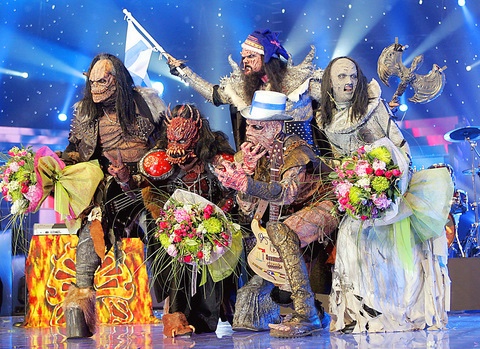
The winner was Finland with the heavy metal-song Hard Rock Hallelujah, performed by Lordi and written by lead singer Mr. Lordi. This was Finland’s first victory in the contest – and first top five placing – in 45 years of participation, the longest time a country had competed without a win at that point. It was also the first ever hard rock song to win the contest, as well as the first band to win since 1997. Russia, Bosnia and Herzegovina, Romania and Sweden rounded out the top five. Bosnia and Herzegovina achieved their best result in their Eurovision history. Further down the table, Lithuania also achieved their best result to date, finishing sixth. Of the Big Four countries Germany placed the highest, finishing joint fourteenth (with Norway).
It’s that time of year again: the Eurovision Song Contest. Last year I was enjoying the show in my PJ’s on the couch, but tonight Edo and I are going to visit friends with several people to experience the ‘annual spectacle’ in a group. The exciting question Will We Win This Year? has been taken from us, so we will relax and only have eyes for the beautiful men and the ugly dresses.
This week the 50th edition of the annual Eurovision Song Contest was held in Kyiv, Ukraine, following the country’s victory at the 2004 contest with the song Wild Dances by Ruslana. Organised by the European Broadcasting Union (EBU) and host broadcaster National Television Company of Ukraine (NTU), the contest was held at the Palace of Sports, and consisted of a semi-final on 19 May, and a final on 21 May 2005. The two live shows were presented by Ukrainian television presenters Maria Efrosinina and Pavlo Shylko.
Thirty-nine countries participated in the contest, three more than the previous record of thirty-six, that took part the year before. Bulgaria and Moldova made their first participation this year, while Hungary returned to the contest after a six-year absence, having last taken part in 1998.
An official CD and DVD was released and a new introduction was an official pin set, which contains heart-shaped pins with the flags of all thirty-nine participating countries. The EBU also commissioned a book The Eurovision Song Contest – The Official History by British/American author John Kennedy O’Connor to celebrate the contest’s fiftieth anniversary. The book was presented on screen during the break between songs 12 and 13 (Serbia and Montenegro, Denmark). The book was published in English, German, French, Dutch, Swedish, Danish and Finnish.
During the semi-final, there were a few sound faults, most notably during the Norwegian song, shortly after the intro and also during the Irish song. These were not fixed for the DVD release.
Following Istanbul’s Under The Same Sky, the slogan for the 2005 show was Awakening, which symbolised the awakening of the country and city ready to present itself to Europe. The postcards (short clips shown between performances) for the 2005 show illustrated Ukraine’s culture and heritage along with a more modern and industrial side to the country.This was the first edition to be broadcast in widescreen 16:9 format.
The Netherlands did not qualify for the final on Saturday. My Impossible Dream by Glennis Grace got 53 point and ended as 14th in the semi-final.
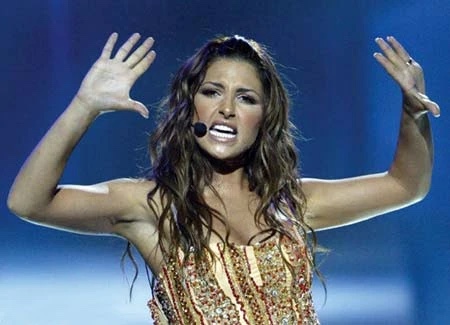
The winner was Greece with the song My Number One, performed by Helena Paparizou and written by Manos Psaltakis, Christos Dantis and Natalia Germanou. This was Greece’s first victory in the contest after 31 years of participation. Malta, Romania, Israel and Latvia rounded out the top five. Malta equalled their best result from 2002, while Romania achieved their best result in their Eurovision history. Unusually, all Big Four countries (France, Germany, Spain and United Kingdom) ended up as the Last Four, all placing in the bottom four positions in the final





 euro-vision.blog