Chanson & Pop

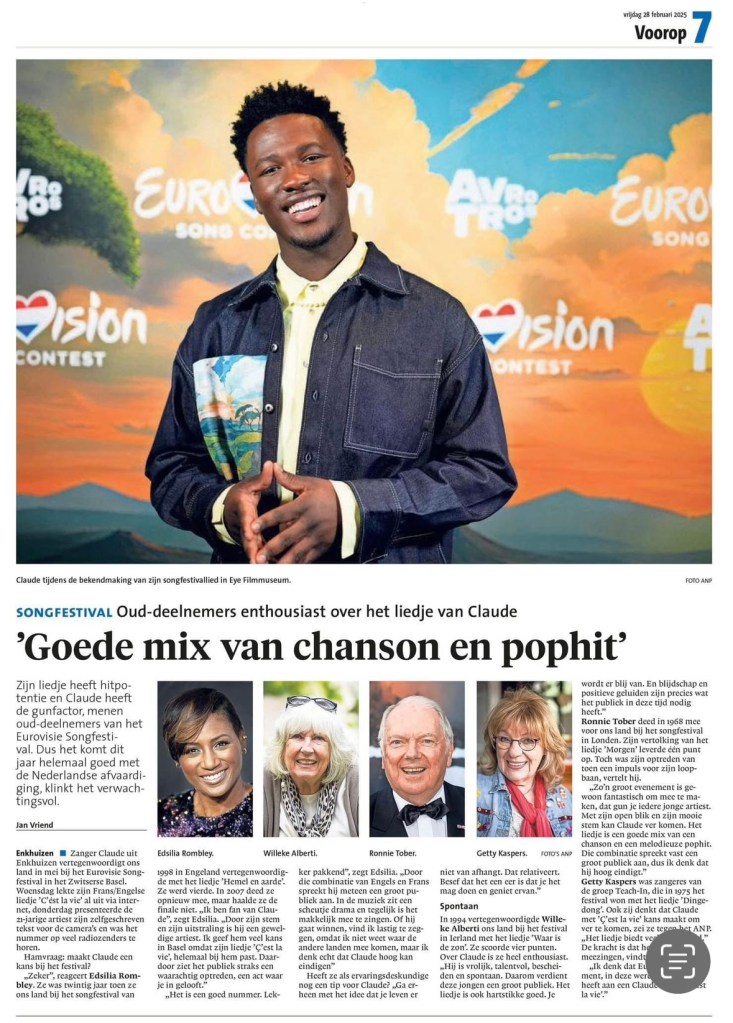
Claude from Enkhuizen will represent our country in May at the Eurovision Song Contest in Basel, Switzerland. On Wednesday, his French/English song C’est la vie was leaked via the internet, and on Thursday the 21 year-old artist presented his self-written lyrics to the cameras and the song was played on many radio stations.

The big question: does Claude have any chance at the festival?

“Certainly,” responds Edsilia Rombley. She was twenty years old when she represented our country at the 1998 Eurovision Song Contest in England with the song Hemel en aarde. She became fourth. In 2007 she participated again, but did not qualify into the final. I am a fan of Claude,” Edsilia says. “His voice and charisma make him a great artist. I give him a great chance in Basel because his song C’est la vie suits him perfectly. That way the audience will see a real performance, an act that you believe in.” It is a good song. Very catchy. With that combination of English and French he immediately appeals to a large audience. There is a dash of drama in the music and at the same time it is easy to sing along. Whether he will win, I find it hard to say, because I don’t know the other entries, but I really think that Claude can finish high.” 

Does she have any tips for Claude as an expert by experience? “Go with the idea that your life doesn’t depend on it. That puts things into perspective. Realize that it is an honor that you can do it and enjoy it.”

In 1994, Willeke Alberti represented our country at the festival in Ireland with the song Waar Is De Zon. We scored four points. She is very enthusiastic about Claude. “He is cheerful, talented, modest and spontaneous. That is why this boy deserves a large audience. The song is also really good. It makes you happy. And joy and positive sounds are exactly what the public needs in this day and age.”

Ronnie Tober participated for our country in the Eurovision Song Contest in London in 1968. His rendition of the song Morgen earned one point. Yet his performance at that time was an impetus for his career, he says.

Such a big event is simply fantastic to experience, you want that for every young artist. With his open mind and his beautiful voice, Claude will qualify. The song is a good mix of a chanson and a melodious pop hit. That combination will certainly appeal to a large audience, so I think he will end up high.”

Getty Kaspers was the singer of the group Teach-In, who won the festival in 1975 with the song Dingedong. She also thinks that Claude has a chance to be a top 5 winner with C’est la vie, she told the ANP. The song offers a lot of joy.” The power is that the audience can sing along, she thinks.

I think that Europe at this moment, in this world, needs a Claude and a C’ést la vie“. Source: Jan Vriend, Noord Hollands Dagblad.
Het Grote Songfestivalfeest

Het Grote Songfestivalfeest returns for fourth edition, with the 2024 event taking place on December 12.

Het Grote Songfestivalfeest is back, with the date of the event for 2024 being announced today. The show which has been held since 2019 will take place at the Ziggo Dome, bringing together past Eurovision Song Contest participants and winners.

Just like last year, Edsilia Rombley will host Het Grote Songfestivalfeest 2023, joined by the Dutch commentator Cornald Maas. Tickets are on sale now here, with tickets starting at € 44.80.

Het Grote Songfestivalfeest 2023 is currently available to watch on BBC iPlayer in the United Kingdom, NRK in Norway and will be broadcast on NPO 3 around Eurovision 2024. Source: Het Grote Songfestivalfeest.

Eurovision 2007

This week the 52nd edition of the annual Eurovision Song Contest was held in Helsinki, Finland, following the country’s victory at the 2006 contest with the song Hard Rock Hallelujah by Lordi. Organised by the European Broadcasting Union (EBU) and host broadcaster Yleisradio (YLE), the contest was held at the Hartwall Areena, and consisted of a semi-final on 10 May, and a final on 12 May 2007. The two live shows were presented by Finnish television presenter Jaana Pelkonen and musician and TV-host Mikko Leppilampi. In addition, Krisse Salminen acted as guest host in the green room, and reported from the crowds at the Senate Square.

Forty-two countries participated in the contest – three more than the previous record of thirty-nine, that took part in 2005. The EBU decided to put aside its limit of 40 countries, which would have meant excluding some countries using a ranking order scheme. The Czech Republic and Georgia participated for the first time this year, with Montenegro and Serbia taking part as independent nations for the first time. Austria and Hungary both returned, after their absence from the previous edition. Meanwhile, Monaco decided not to participate, despite initially confirming participation. Monaco has not competed in Eurovision Song Contest ever since.

On 12 March 2007, the draws for the running order for the semi-final, final and voting procedure took place. A new feature allowed five wild-card countries from the semi-final and three countries from the final to choose their starting position. The heads of delegation went on stage and chose the number they would take. In the semi-final, Austria, Andorra, Turkey, Slovenia and Latvia were able to choose their positions. In the final, Armenia, Ukraine and Germany were able to exercise this privilege. All countries opted for spots in the second half of both evenings. Shortly after the draw, the entries were approved by the EBU, ending the possibility of disqualification for the Israeli song. The United Kingdom chose their entry after the deadline because they were granted special dispensation from the EBU.

The contest saw some minor changes to the voting time-frame. The compilation summary video of all entries including phone numbers was shown twice. The voting process was the same as 2006 except there was fifteen minutes to vote, an increase of five minutes on the 2006 contest. In the final, the results from each country were once again shown from one to seven points automatically on screen and only eight, ten and twelve were read by the spokespeople.

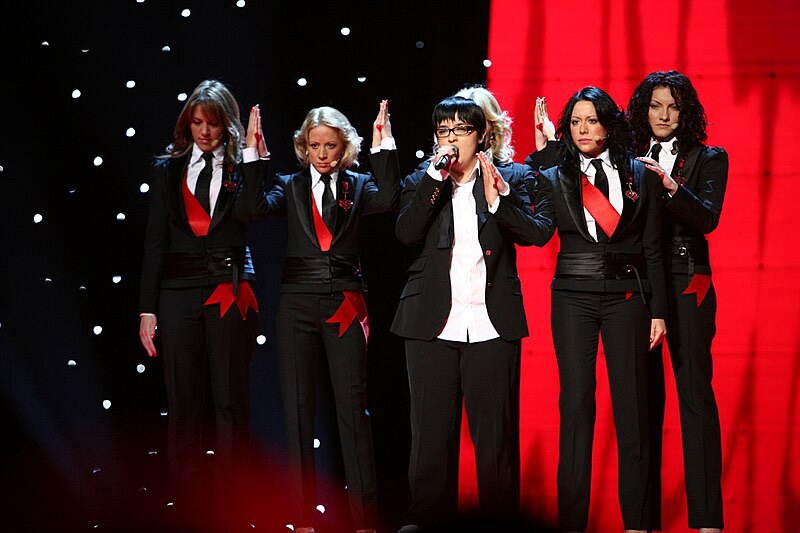
The winner was Serbia with the song Molitva, performed by Marija Šerifović and written by Vladimir Graić and Saša Milošević Mare. This was Serbia’s first victory in the contest, coincidentally the first year it competed as an independent nation. It was also the first winning song entirely performed in a country’s native language since Israel’s Diva in 1998. Ukraine, Russia, Turkey and Bulgaria rounded out the top five. Further down the table, Belarus achieved their best placing to date, finishing sixth. Meanwhile, Ireland achieved its worst placing in the contest up until that point, finishing twenty-fourth (last place) in the final. Of the Big Four countries, Germany placed the highest, finishing nineteenth.

Eurovision 1998

Today the 43rd edition of the annual Eurovision Song Contest 1998 took place at the National Indoor Arena in Birmingham, United Kingdom. Organised by the European Broadcasting Union (EBU) and host broadcaster the British Broadcasting Corporation (BBC) and presented by Terry Wogan and Ulrika Jonsson, the contest was held in the United Kingdom following the country’s victory at the 1997 contest with the song Love Shine a Light by Katrina and the Waves.

Twenty-five countries participated in the contest. Six participating countries in the 1997 edition were absent, with Austria, Bosnia and Herzegovina, Denmark, Iceland and Russia relegated due to achieving the lowest average points totals over the previous five contests and Italy actively choosing not to participate. These countries were replaced by Macedoniain its first contest appearance, and previously relegated and absent countries Belgium, Finland, Israel, Romania and Slovakia.

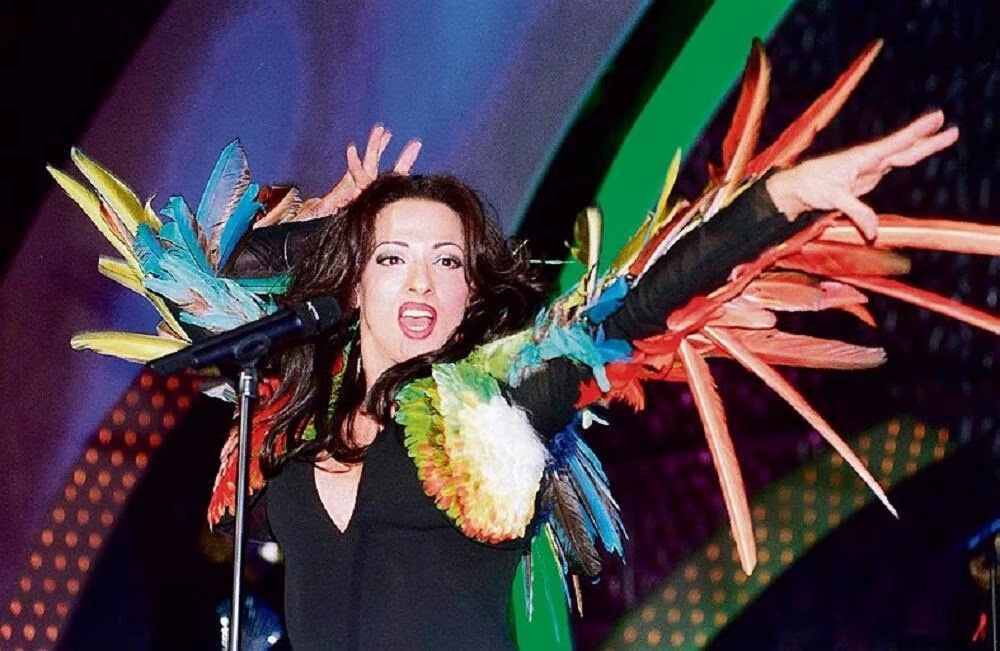
The winner was Israel with the song Diva, composed by Svika Pick, written by Yoav Ginai and performed by Dana International. The United Kingdom, Malta, the Netherlands and Croatia rounded out the top five. Dana International was the contest’s first openly transgender participant and became the contest’s first openly LGBTQ+ winning artist; however, her participation for Israel was controversial among sections of Israeli society and resulted in opposition and death threats against her in the run-up to the contest.

It was the first contest in which the results were determined predominantly through televoting, and would become the last contest in which all participants were required to perform in the language of their country and the last to feature an orchestra and live music accompaniment for the competing entries.