Genius or Madness?

The Dutch TV Guides pay attention to the Eurovision Song Contest this week. The Veronica Superguide pays attention to the Dutch act of 2024: Joost Klein, and asks on their cover: Genius or madness?

It’s ‘that time of year’ again and this time it’s Joost Klein who represents the Netherlands with the crazy Europapa at the Eurovision Song Contest, which is now being held in Sweden. Remarkable? Rather!

There are few songs that cause as much controversy as that of Joost Klein, our entry for the Eurovision Song Contest 2024. Europapa, with a pounding gabber beat full of creative rhyme schemes and wordplay, is very different from our previous entries. Many people wonder: is Europapa a brilliant move or are we going completely wrong with this? According to Alexander van Eenennaam, music journalist at the AD and Song festival expert, it is only logical that the relatively unknown Joost Klein and his song were chosen. “Since Anouk’s participation in 2013, the selection committee has only looked at the song itself and no longer at the fame of the artist. That explains why Joost was considered in the first place,” he explains. “The other songs that had a chance were more common songs, which we have often seen at the Eurovision Song Contest. Europapa may be a bit crazy, but according to the jury it was really the very best song. It may not be to your taste, personally I wouldn’t put the song on at home, but the song is excellent within its genre.”

Alexander emphasizes that there is more behind the song there is only some happy hardcore. Europapa tells the story of Joost who lost both parents at a young age. In the song, he travels through Europe as an orphan to find himself. His parents gave him a broad vision of the world in their upbringing, namely that there are no boundaries. After a long chopping session to some pounding beats, Joost immediately addresses his parents. “I miss you every day, is what I secretly whisper. See, dad, I listened to you,” sings the blonde Frisian. A surprisingly emotional end to the cheerful song. “That emotional charge is important, because it makes Europapa more than just a gimmick,” the journalist explains. It is perhaps also the biggest difference from this year’s other entries. For example, Finland has the song No Rules! from the dance duo Windows95man. It is cheerful, striking and, like Joost, harks back to the recognizable and popular music of the nineties, but still misses the point. The song revolves around a man with long curly hair, a white cap and a shirt with the Windows 95 logo on it. He also wears skin-colored briefs until he finally finds pants. The message: don’t take everything so seriously. In any case, it makes a much less impression with the bookmakers than Joost, as the act is currently at number thirteen.

In 2019, the Netherlands made history thanks to Duncan Laurence, whose emotional ballad Arcade took first place. Europapa is so much different from Duncan’s entry. The question is why we didn’t go for a quiet emotional song again? Alexander notes that the pace of Eurovision entries has increased every year. In 2024, there are almost no ballads. According to the AD journalist, this has to do with a major change in the voting procedure. Where everything used to be in the hands of the professional jury, nowadays the opinion of the viewer also plays a major role. During the semi-finals, the public decides via televoting which country will go to the final. And that can be useful for Joost, the Eurovision expert explains. “Ballads don’t do well with the viewers. They are less likely to enter your living room. Such a striking song as Europapa is more likely to attract the attention of people at home and get more votes.” This is also where the power of social media comes into play, something Joost has mastered well. “He is a born marketer and grew up with social media. He is so good at it that he can easily reach people at home.” He previously proved that he knows how to gain fans through social media with his hit Friesenjung, which ended up in countries such as Germany and Austria via TikTok videos and became a true hit there.

While writing this article, Joost is number three among the bookmakers. So it’s starting to look more and more like we can make a profit with Europapa. “Anything is possible, but it all depends on the performance itself,” says Alexander. “We don’t know yet what he will do on stage. But without knowing exactly what his act will look like, I dare to predict that he will become number one with the audience. The only question is whether he will able to touch the professional jury with his message.” But according to the music expert, that no longer matters. Europapa has been listened to millions on YouTube and dominates the radio in countries such as Belgium, Germany and France. “Actually, Joost has already won.”

Text: Merel van Baal; Veronica Superguide

Eurovision 2021

This week the 65th edition of the annual Eurovision Song Contest took place in Rotterdam, Netherlands, following the country’s win at the 2019 contest with the song Arcade by Duncan Laurence. The Netherlands was set to host the 2020 contest, before it was cancelled due to the COVID-19 pandemic. Organised by the European Broadcasting Union (EBU) and host broadcasters Nederlandse Publieke Omroep(NPO), Nederlandse Omroep Stichting (NOS) and AVROTROS, the contest was held at Rotterdam Ahoy, and consisted of two semi-finals on 18 and 20 May, and a final on 22 May 2021. The three live shows were presented by Dutch television presenters and singers Chantal Janzen, Edsilia Rombley and Jan Smit, and Dutch YouTuber and make-up artist Nikkie de Jager.

Thirty-nine countries participated in the contest, of which twenty-six re-entered the artists chosen for 2020 (albeit with different songs, as per the contest’s rules). Bulgaria and Ukraine returned after their absence from the 2019 contest, while Hungary and Montenegro did not return after their participation in the 2019 edition. Armenia and Belarus had originally planned to participate, but Armenia withdrew due to its social and political crises following the Second Nagorno-Karabakh War, and Belarus was disqualified after submitting entries in violation of the rules twice, and not providing an eligible entry before the deadline.

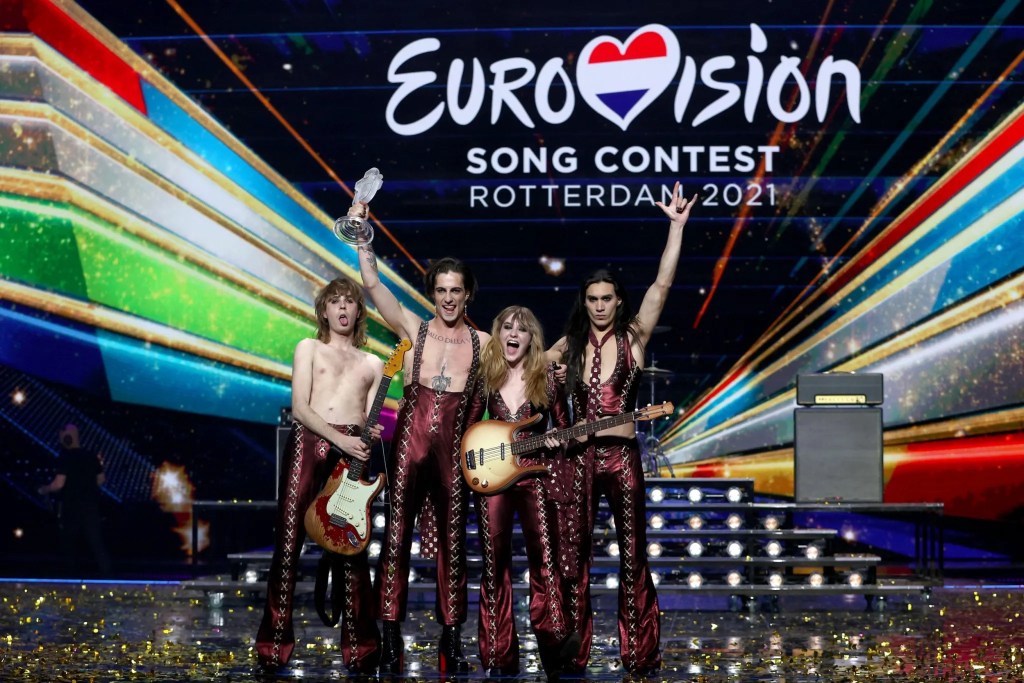
The winner was Italy with the song “Zitti e buoni“, performed by Måneskin and written by the band’s members Damiano David, Ethan Torchio, Thomas Raggi and Victoria De Angelis. France, Switzerland, Iceland and Ukraine rounded out the top five, with France and Switzerland achieving their best results since 1991 and 1993 respectively. Italy won the combined vote and televote, but placed fourth in the jury vote after Switzerland, France, and Malta. Italy was the second member of the “Big Five” since its introduction to win the contest after Germany in 2010. For the first time since 1995, none of the top three entries were performed in English, with France and Switzerland performing in French, and Italy in Italian.

Also, for the first time since the current voting system was implemented in 2016, more than one country received no points from the televote in the final; these countries were Germany, Spain, the host country the Netherlands, and the United Kingdom, the last of those becoming the first country to receive no points from both the jury and televote. It was the second time that the United Kingdom had received no points in the contest, the last time having been in 2003. For the first time since its debut in 2015, Australia failed to qualify for the final, making Ukraine the only country that has never failed to qualify from the semi-finals since their introduction in 2004.

The EBU reported that the contest had an audience of 183 million viewers in 36 European markets, an increase of a million viewers from the previous edition, with an increase of seven percent in the 15–24 year old age range.

For this year, delegations were given the option to use pre-recorded backing vocals. Each delegation could still choose to use backing singers, whether on or off stage, or a combination of live and recorded backing vocals. All lead vocals performing the melody of the song must still be live, according to the rules. As a measure to guarantee that all participants could take part in the contest, every national broadcaster were required to create a ‘live-on-tape’ backup recording prior to the contest, which could be used if a participant was unable to travel to Rotterdam, or subjected to quarantine on arrival. The recordings took place in a studio setting, in real-time (as it would be at the contest) without any edits to the vocals or any part of the performance itself after the recording. A set of production guidelines was also revealed to ensure fairness and the integrity of the recordings.

Other rules for the entries stayed the same in the 2021 contest. This includes that the maximum length for a song is three minutes, that there can be at most six performers on stage, and that the compositions (lyrics and music) must not have been commercially released before 1 September of the year before. Following the cancellation of the 2020 contest, the EBU explored the option of allowing the songs selected for the 2020 contest to compete in the 2021 contest, which needed to be discussed with the Eurovision Song Contest reference group and the national broadcasters. Victoria, Bulgaria’s representative for 2020 and 2021, publicly expressed her support for such a move. However, on 20 March 2020, the reference group decided that, in accordance with the rules of the Eurovision Song Contest, the 2020 songs would not be eligible to compete in the 2021 contest.

Eurovision 2020

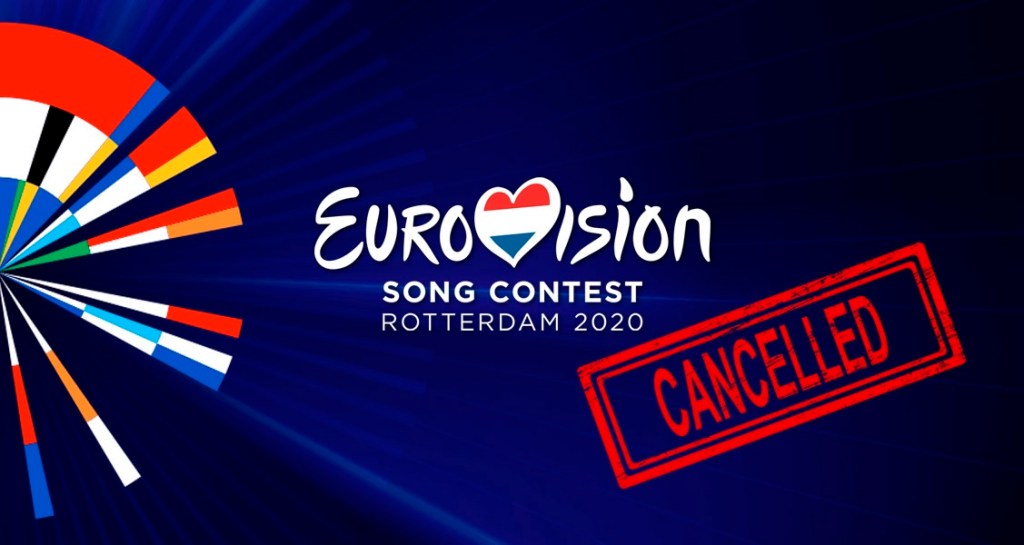
The Eurovision Song Contest 2020 was planned to be the 65th edition of the Eurovision Song Contest. It would have taken place in Rotterdam, Netherlands, following the country’s victory at the 2019 contest with the song Arcade by Duncan Laurence. This edition was the first and only one in the contest’s history to be cancelled, with it being called off on 18 March 2020 due to the COVID-19 pandemic.

The contest was scheduled to be held at Rotterdam Ahoy and would have consisted of two semi-finals on 12 and 14 May, and a final on 16 May 2020. Forty-one countries would have participated in the contest; Bulgaria and Ukraine would have returned after their absence from the 2019 contest, while Hungary and Montenegro had confirmed their non-participation after taking part in the previous edition. All 41 competing artists and songs were confirmed by the relevant broadcasters by early March 2020.

Following the cancellation, the European Broadcasting Union (EBU) began discussions of potential carryovers for the 2021 contest, such as the host city and participating artists, with various parties. In place of the cancelled contest, the EBU and its Dutch members NPO, NOS and AVROTROS organised a replacement show, Eurovision: Europe Shine a Light, to showcase the selected entries on 16 May, the day of the planned final. Rotterdam remained host of the 2021 contest on 18, 20 and 22 May 2021; however, the songs selected for the 2020 contest were not eligible for the competition.

Eurovision 2019

This week the 64th edition of the annual Eurovision Song Contest took place in Tel Aviv, Israel, following the country’s victory at the 2018 contest with the song Toy by Netta. Organised by the European Broadcasting Union (EBU) and host broadcaster the Israeli Public Broadcasting Corporation (IPBC/Kan), the contest was held at Expo Tel Aviv, and consisted of two semi-finals on 14 and 16 May, and a final on 18 May 2019. The three live shows were presented by Israeli television presenters Erez Tal, Assi Azar and Lucy Ayoub, and Israeli model Bar Refaeli.

Forty-one countries participated in the contest, with Bulgaria and Ukraine not returning after their participation in the previous edition. Bulgaria cited financial difficulties as the reason for its absence, while Ukraine, which had originally planned to participate, ultimately withdrew as a result of a controversy surrounding its national selection.

The winner was the Netherlands with the song Arcade, performed by Duncan Laurence and written by Laurence along with Joel Sjöö, Wouter Hardy and Will Knox. Italy, Russia, Switzerland and Sweden rounded out the top five; due to a voting error, Norway was originally placed fifth, but placed sixth after a correction. The Netherlands won the combined vote, but placed third in the jury vote after North Macedonia and Sweden, and second in the televote after Norway. Further down the table, North Macedonia and San Marino achieved their best results to date, finishing seventh and 19th respectively.

The EBU reported that the contest had an audience of 182 million viewers in 40 European markets, a decrease of 4 million viewers from the previous edition. However, an increase of two percent in the 15–24 year old age range was reported.