
This week the 65th edition of the annual Eurovision Song Contest took place in Rotterdam, Netherlands, following the country’s win at the 2019 contest with the song Arcade by Duncan Laurence. The Netherlands was set to host the 2020 contest, before it was cancelled due to the COVID-19 pandemic. Organised by the European Broadcasting Union (EBU) and host broadcasters Nederlandse Publieke Omroep(NPO), Nederlandse Omroep Stichting (NOS) and AVROTROS, the contest was held at Rotterdam Ahoy, and consisted of two semi-finals on 18 and 20 May, and a final on 22 May 2021. The three live shows were presented by Dutch television presenters and singers Chantal Janzen, Edsilia Rombley and Jan Smit, and Dutch YouTuber and make-up artist Nikkie de Jager.
Thirty-nine countries participated in the contest, of which twenty-six re-entered the artists chosen for 2020 (albeit with different songs, as per the contest’s rules). Bulgaria and Ukraine returned after their absence from the 2019 contest, while Hungary and Montenegro did not return after their participation in the 2019 edition. Armenia and Belarus had originally planned to participate, but Armenia withdrew due to its social and political crises following the Second Nagorno-Karabakh War, and Belarus was disqualified after submitting entries in violation of the rules twice, and not providing an eligible entry before the deadline.
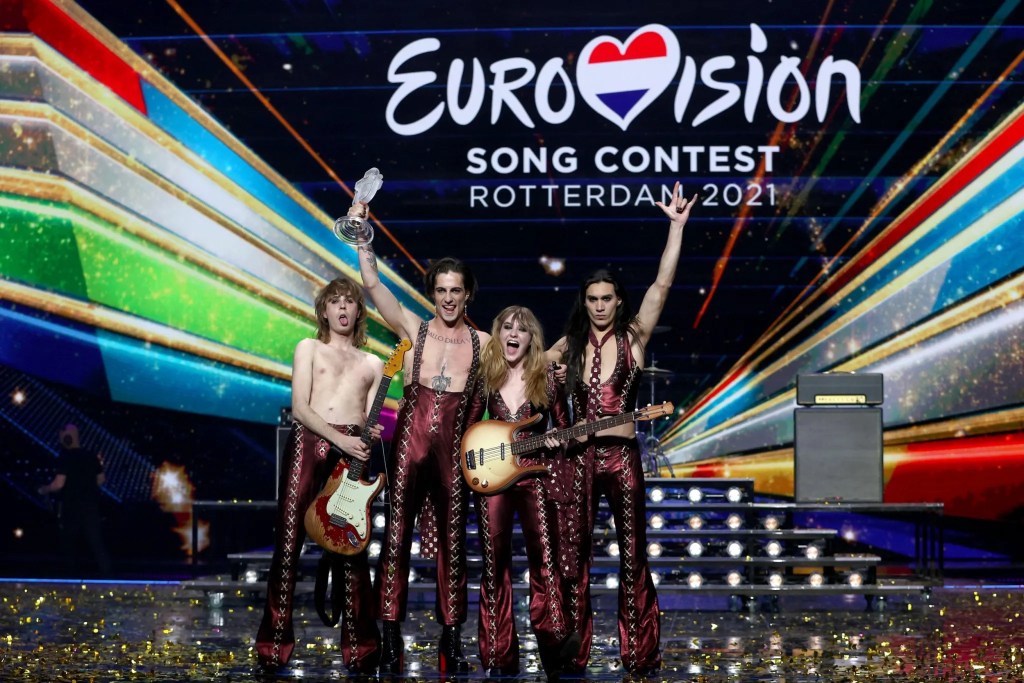
The winner was Italy with the song “Zitti e buoni“, performed by Måneskin and written by the band’s members Damiano David, Ethan Torchio, Thomas Raggi and Victoria De Angelis. France, Switzerland, Iceland and Ukraine rounded out the top five, with France and Switzerland achieving their best results since 1991 and 1993 respectively. Italy won the combined vote and televote, but placed fourth in the jury vote after Switzerland, France, and Malta. Italy was the second member of the “Big Five” since its introduction to win the contest after Germany in 2010. For the first time since 1995, none of the top three entries were performed in English, with France and Switzerland performing in French, and Italy in Italian.
Also, for the first time since the current voting system was implemented in 2016, more than one country received no points from the televote in the final; these countries were Germany, Spain, the host country the Netherlands, and the United Kingdom, the last of those becoming the first country to receive no points from both the jury and televote. It was the second time that the United Kingdom had received no points in the contest, the last time having been in 2003. For the first time since its debut in 2015, Australia failed to qualify for the final, making Ukraine the only country that has never failed to qualify from the semi-finals since their introduction in 2004.
The EBU reported that the contest had an audience of 183 million viewers in 36 European markets, an increase of a million viewers from the previous edition, with an increase of seven percent in the 15–24 year old age range.
For this year, delegations were given the option to use pre-recorded backing vocals. Each delegation could still choose to use backing singers, whether on or off stage, or a combination of live and recorded backing vocals. All lead vocals performing the melody of the song must still be live, according to the rules. As a measure to guarantee that all participants could take part in the contest, every national broadcaster were required to create a ‘live-on-tape’ backup recording prior to the contest, which could be used if a participant was unable to travel to Rotterdam, or subjected to quarantine on arrival. The recordings took place in a studio setting, in real-time (as it would be at the contest) without any edits to the vocals or any part of the performance itself after the recording. A set of production guidelines was also revealed to ensure fairness and the integrity of the recordings.
Other rules for the entries stayed the same in the 2021 contest. This includes that the maximum length for a song is three minutes, that there can be at most six performers on stage, and that the compositions (lyrics and music) must not have been commercially released before 1 September of the year before. Following the cancellation of the 2020 contest, the EBU explored the option of allowing the songs selected for the 2020 contest to compete in the 2021 contest, which needed to be discussed with the Eurovision Song Contest reference group and the national broadcasters. Victoria, Bulgaria’s representative for 2020 and 2021, publicly expressed her support for such a move. However, on 20 March 2020, the reference group decided that, in accordance with the rules of the Eurovision Song Contest, the 2020 songs would not be eligible to compete in the 2021 contest.

 euro-vision.blog